
Client Alerts & Insights
Union Election Petitions in 2024: The Story So Far; Employer Petitions Skyrocket, but Don’t Detract from Union Petition Rates
March 1, 2024
The Fallout from the NLRB’s Cemex Decision
As we previously addressed (see alert here), the National Labor Relations Board’s (NLRB) August 25, 2023, decision in Cemex Construction Materials Pacific, LLC overturned long-established standards for union recognition and turned the process for recognition on its head. Under Cemex, when a union demands recognition based on majority support, employers can no longer reject evidence of sufficient support by way of authorization cards. Instead, employers are left with two options: presumptively recognize the union as the employees’ bargaining representative, or file an election petition (when filed by the employer, an “RM Petition”) within 14 days of the union’s assertion of majority support.
This framework is a 180-degree turn from the process that was previously in place since 1971, which permitted an employer to refuse to accept evidence of majority support and, in doing so, imposed the affirmative burden to petition for an election (when filed by the union, an “RC Petition”) on the union. In the simplest terms, Cemex took the burden off unions and placed it squarely on employers.
Given this marked burden shift, the NLRB’s Cemex decision was widely anticipated to cause an uptick in RM Petitions, and a corresponding reduction in RC Petitions. Instead, petitions have increased across the board according to limited data available so far in 2024.
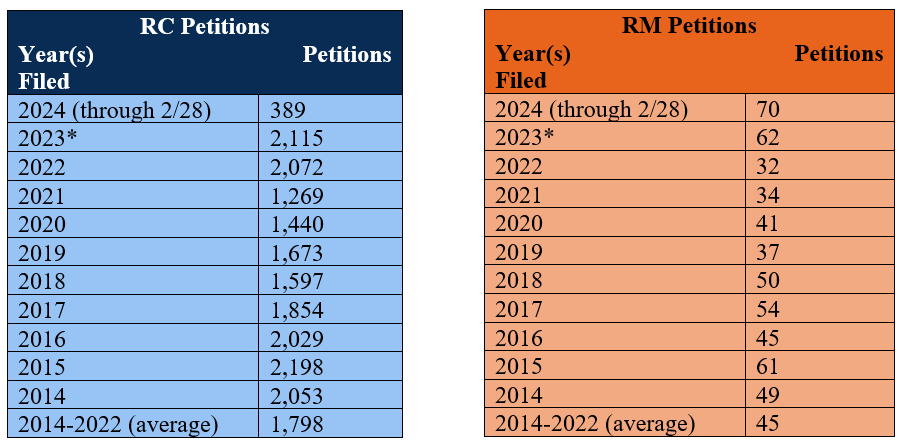
Expectedly, RM Petition rates have skyrocketed. According to data published by the NLRB, an average of 45 RM Petitions were filed annually between 2014 and 2022, with the greatest number (61) filed in 2015. So far in 2024, 70 RM Petitions have already been filed, extrapolating to an expected 443 RM Petitions this year, or an 884% increase in annual filing over the past decade.
Surprisingly, however, the increase in RM Petition filings has not resulted in a corresponding reduction in RC Petition filings. In fact, RC Petition filings also appear to be on the rise so far in 2024. An average of 1,798 RC Petitions were filed annually between 2014 and 2022, with the greatest number (2,198) filed in 2015. So far in 2024, 389 RC Petitions have already been filed, extrapolating to an expected 2,425 RC Petitions this year, or a 35% increase in annual filing over the past decade.
Data from 2023 are shown below but are not included in these trend calculations due to the skewing effect of the August 25 Cemex decision.
 Source: https://www.nlrb.gov/reports/nlrb-case-activity-reports/representation-cases
Takeaways from the Data
The uptick in RM Petition filings in the aftermath of Cemex is unsurprising, given that the alternative is presumptive union representation. Importantly, filing an RM Petition carries a distinct advantage that responding to an RC Petition does not: it allows the employer to put its view of the appropriate bargaining unit in front of the NLRB regional office that will decide the scope of the unit (in the event of a dispute) before the union has the opportunity to do so (see prompt 5a in the RM Petition). Ultimately, in the current environment, when a union presents evidence demonstrating majority support, it is typically in the employer’s interest to promptly submit an RM Petition.
The simultaneous uptick in RC Petitions suggests that unions have been spurred on by the heavily pro-labor Board under the current administration, and perceive the current political and administrative climate as creating favorable timing to seek certification. The Board’s aggressively pro-labor activities in the past several years—particularly 2023—support their conclusion (see, for example, alerts on the Board’s 2023 acceleration of union elections, assaults on captive audience meetings, restriction of other “persuader” activities and of handbook provisions, opposition to restrictive covenant provisions in employment contracts, and expansion of unfair labor practice charge remedies).
The best prophylactic measure that employers can take is to maintain positive relations with their non-union workforce to dissuade organizing efforts. The union organizing process is littered with traps for the unwary employer and can create the basis for one or more costly unfair labor practice charges. Employers who become aware of potential unionization efforts should promptly consult with counsel to understand what can be said, and in what context, to union organizers and would-be union employees, both before and after a petition is filed.
To learn how these developments can affect your business, contact a member of Benesch’s Labor & Employment Practice Group.
W. Eric Baisden at ebaisden@beneschlaw.com or 216.363.4676.
Adam Primm at aprimm@beneschlaw.com or 216.363.4451.
Eric M. Flagg at eflagg@beneschlaw.com or 216.363.6196.