Client Alerts & Insights
Supply Chain Strategy Today: Managing Through Policy, Trade & Technology Unknowns
June 25, 2025
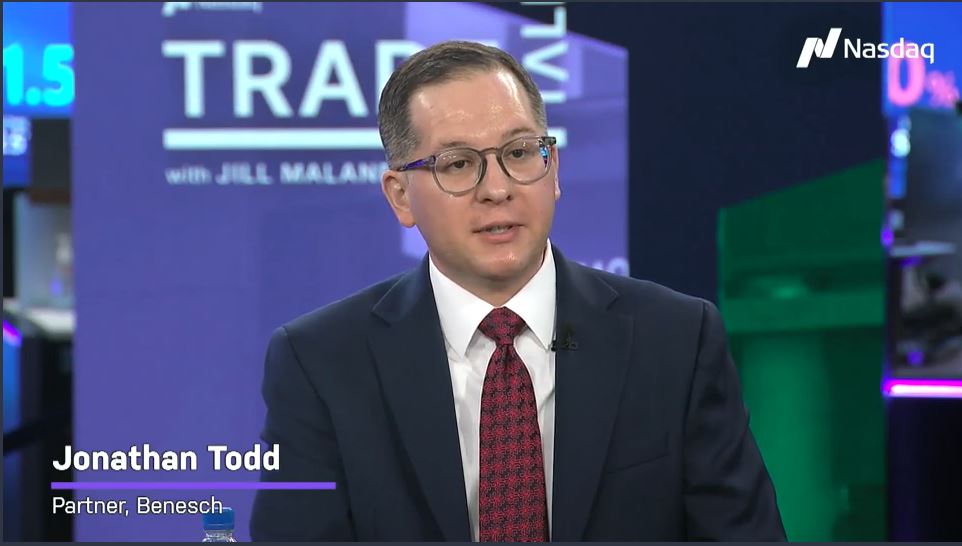
The supply chain management discipline has never been more important for businesses than right now. It was my pleasure to discuss the current state of transportation, trade and supply chain policy during a live broadcast of Nasdaq’s TradeTalks from the MarketSite in Times Square. The in-depth conversation, moderated by Jill Malandrino, covered a wide range of pressing issues facing businesses large and small, at home and abroad. We explored a range of driving factors, including changing tariff regimes, national security challenges, data protection, and the growing role of artificial intelligence in business operations.
Here are a few key takeaways from that broadcast:
1. Business Decisions are Tactical Right Now, but a Return to Strategy is Coming.
Clients tell me every day that business operations turned tactical in Q2 of 2025. As I shared during the panel discussion, I have clients who had plans to make capital investments in the United States in Q1, but the pencils went down by Q2 due to the speed of change. I am an optimist expecting far greater clarity on where things stand, good or bad, sometime around Q3 of this year. It is time for business to get back to doing what it does best: strategic planning and deployment of resources for future jobs and revenue growth.
2. Awareness is the Number One Challenge.
The term “uncertainty” oversimplifies this business and regulatory environment. Every supply chain is different. For most, the challenges include tariff change, sanctions and export controls change, geopolitical risk, and disruptive technologies. Keeping pace with the speed of change in a way that allows for making long-term investment, let alone managing daily sourcing and production, is difficult to say the least. Maintaining quality awareness is the first order of business. Then we work with clients to develop lawful solutions by examining available alternatives and their relative impacts through future contingencies.
3. This is a Higher Cost Operating Environment.
A cold hard fact is simply that this is a higher cost operating environment. Tariffs are top of mind for all businesses in the United States. Everyone is looking to manage cost shocks in raw materials supply and finished goods. Larger companies have spent much of this year renegotiating supply agreements for price and volume, identifying new suppliers and new production strategies, and communicating those changes as necessary to customers. This is challenging, but for small and mid-sized companies, it is far more difficult without the bandwidth or financial leverage to utilize that tactical playbook. Remaining calm and relying on experience is essential.
4. Compliance Risks Are Complex for Domestic Business.
Regulatory compliance is not just about trade. AI, automation and other technologies are an essential part of the puzzle for competitive supply chains. Clients are beginning to use these resources right now for production planning, asset utilization, inventory management and delivery routing. The United States does not have a comprehensive regulatory approach to these technologies or regulatory obligations, as is the case in other countries and trading blocks. Here, for example, using biometric technologies on factory and warehouse floors triggers varying regulatory obligations under state laws. Effectively managing compliance is a parallel exercise to good strategy.
5. Global Competition Never Stops.
Clients often tell me that government doesn’t understand supply chain. In fairness, there has been progress in easing regulatory burden at the federal level as well as the cost of compliance. More work remains to be done. There is bipartisan support for most foundational issues driving policy. It is hard to disagree with more investment, better jobs and protecting the homeland. Still, some countries and regions are more aggressive in uniformly preparing for coming changes to global production and trade. A disconnect between policy and operational reality makes capital investment and R&D more difficult, and in the extreme, it can leave domestic interests behind global trends and trade networks.
Watch the full panel discussion here: The Intersection of Transportation, Trade and Supply Chain Policies | Nasdaq
For more insight on how these supply chain trends may impact your business, contact Benesch Partner Jonathan Todd at jtodd@beneschlaw.com or 1-216-363-4658.
Benesch client alerts and legal publications to help you stay on the cutting edge of developments are available by signing up here.